I visited the
Louisiana international museum of modern art in Copenhagen last saturday, and it was amazing. This place is absolutely transcending. Its location on the costs strikes a balance between landscape, architecture and art in a unique interaction. Beautiful.
I heard of the international renown of that museum, but it is really a "thing" to go there. The whole environment is completely part of the experience. The following pictures talk by themselves.
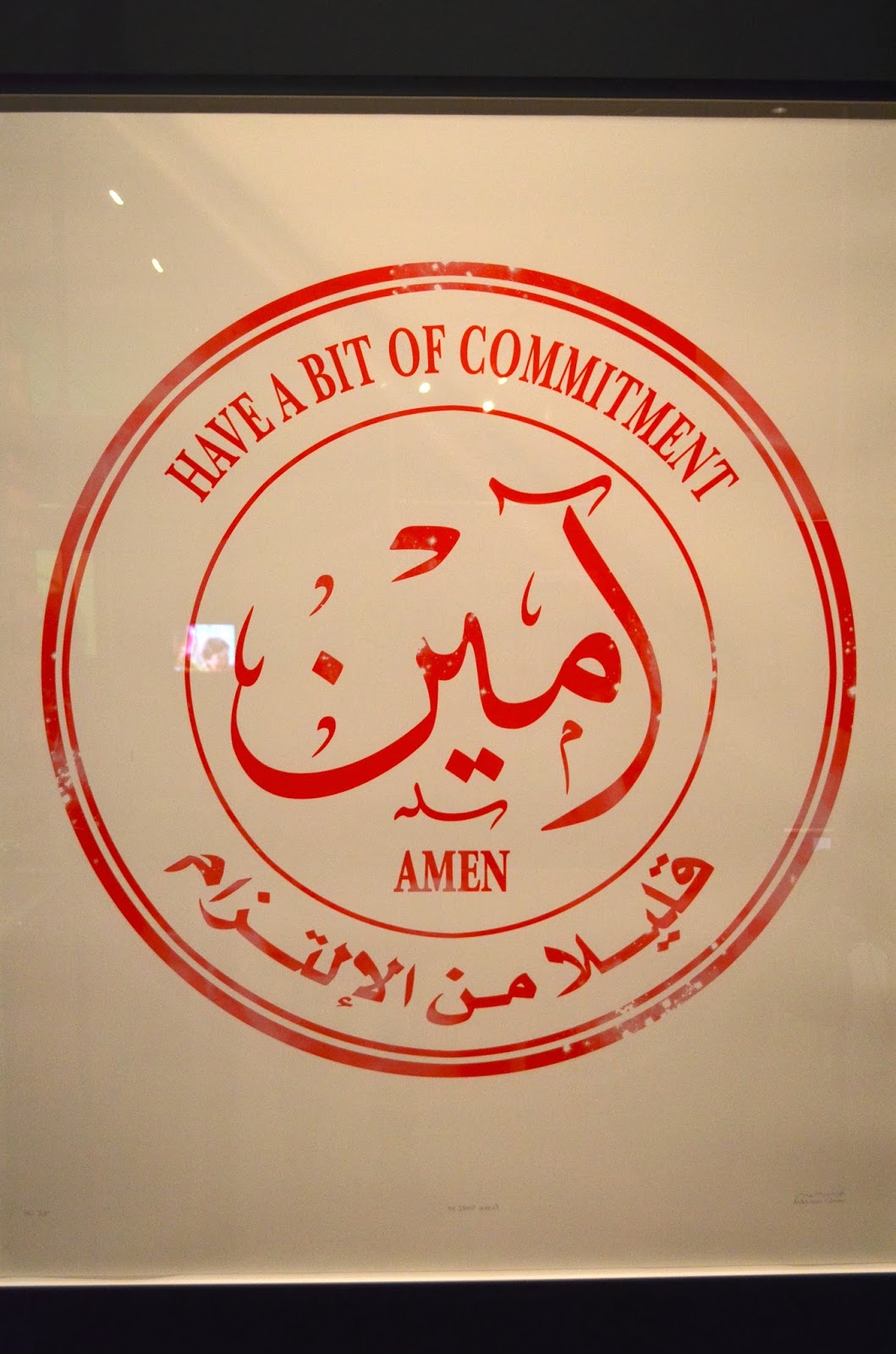
When I went there, one of the exhibitions taking place was that of an Arab Contemporary exhibition : "What is Arab identity to you?". Well, I was obviously appealed by such a title. As a Tunisian who lived the Tunisian uprising, I was deeply touched to see how Arab culture diversity was highlighted in a harmonious melting. Also, as I already worked for a contemporary arab exhibition about Tunisian identity, I was really inspired by the way artists were addressing the subject. Here are some of the pictures I took at the museum :
Here are some pictures of the Tunisian art projects I saw there. I was deeply touched to see a piece of art of the
Laroussa project, which consists on a collective art project to honour and promote the traditional ceramic art of Sejnane, a rural city in Tunisia.
The artwork of Nadia Kaabi-Linke refers to the political transition in Tunisia, here's the outline of the piece of art :
The OUTSTANDING landscape on the island :
To let you better understand what the exhibition is highlighting, here's the introductory text, which I find very instructive regarding the diversity of Arab cultures and the way to approach and understand them :
The Arabian Nights and The Arab Spring – great contrasts appear when one tries to draw broad lines and create unified narrative for such a large region. Here a number of cultural personalities, from the Arab world answer the question “What is Arab identity to you?”
However, one continent feature for the countries we call the Arab world today is the language and the language of art. The artistic imagery in particular, with its geometric patterns, creates a visual ground for the culture that is evident everywhere in the region. The ornamental can be seen in everything from the Arab carpets to the tile patterns in the courtyards; from the curving characters of the calligraphy to the architecture, in which whole walls and facades are made up of complicated patterns that arise both as part of the construction of the building and as interior elements on the form of semi-transparent room partitions. The arabesque, the symmetrically build-up pattern that seems to be able to continue endlessly, is the common factor in an organic imagery that has its roots on classic Islamic art.
Another common factor is the spatial organization of life, which seems to apply irrespective of the many differences from country to country. Unlike the open fluid spaces that are being developed for example in Nordic architecture today, Arab architecture and culture are based on a razor-sharp separation of private and public space, and of social functions within the many walls of the home, which operates with a number of smaller spaces, the men’s space, the host’s space, the guest’s space…
The traditional semi-private reception room, the majlis, where the host meets his guest, can be seen as characteristic of the way private space is managed. Although the majlis is no longer a fixed component in modern Arab architecture, the phenomenon shows how the organization of rituals and habits is tied to the architectural setting.